Should a small online store offer free shipping? Usually yes, with a threshold
Most shoppers weigh free shipping when they choose where to buy. Here is what the data says, how to work out its cost, and how to test a threshold.
It's a Friday evening. A shopper picks out a candle from your small online store, types in her address, and then sees a shipping fee that is a quarter of the price. She closes the tab and buys a similar one from a bigger shop that ships free. So should a small online store offer free shipping? Usually yes, but only after you work out who pays for it.
Should a small online store offer free shipping?
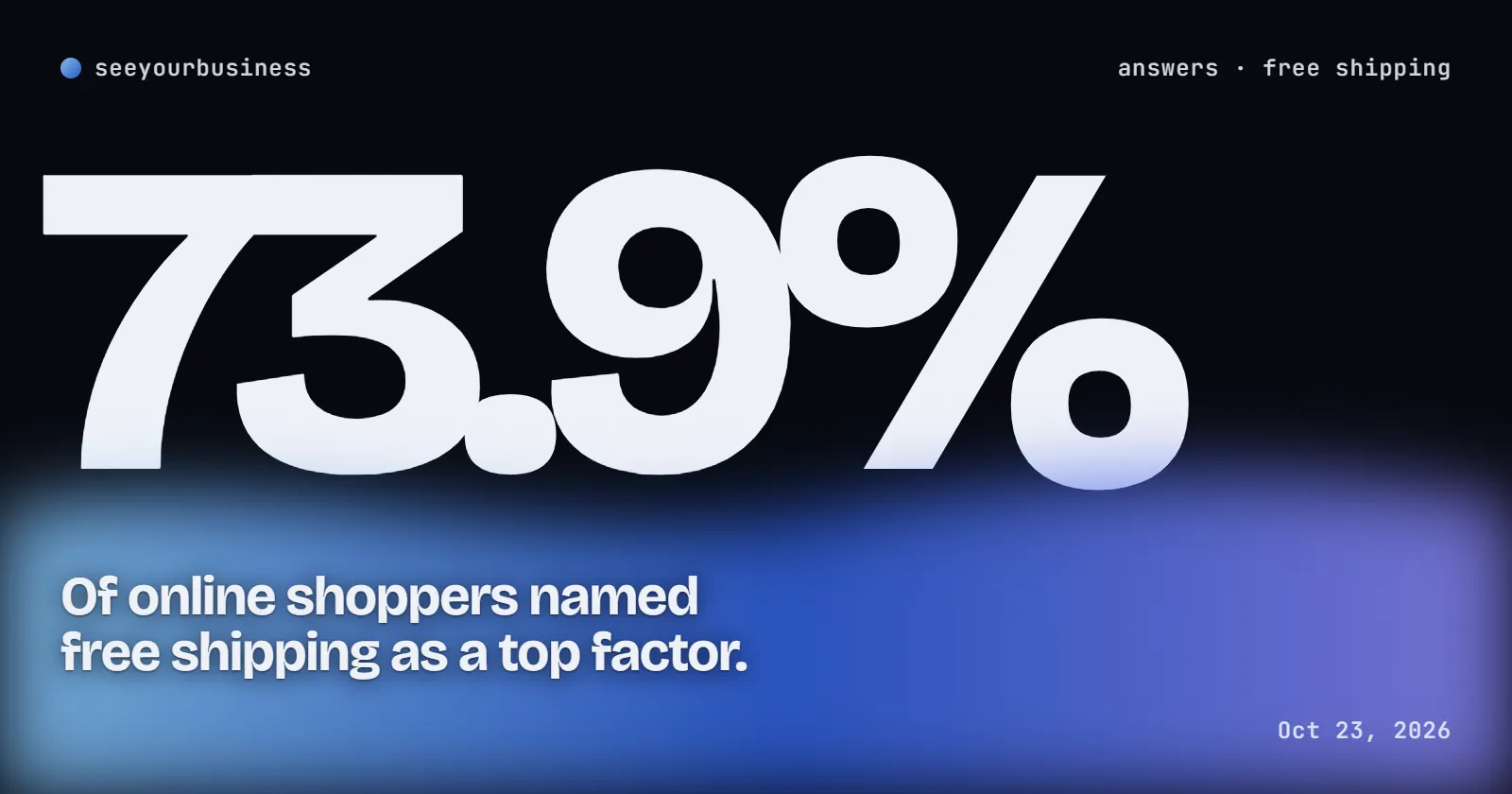
For most small stores, free shipping on orders above a set amount is the safest answer. The shoppers are already telling you what they want. In an October 2025 survey of 1,057 online shoppers by Bizrate Insights and Digital Commerce 360, 73.9% named free shipping as a factor in choosing where to buy, the top answer on the list. Speed of delivery came second at 58.9%, according to Digital Commerce 360.
The big stores have noticed. The same Digital Commerce 360 report says 71.2% of retailers in its Top 1000 database offered free shipping in 2024, up slightly from 71.0% the year before. If you sell candles, pet treats, or coffee beans, the shop your customer compares you with has probably already made that promise.
Say you run a small shop that sells home goods, and you ship about 40 orders a day. Every shopper who leaves at the shipping line is a sale you paid to attract and then lost. That is the cost of getting this wrong, and it does not show up as a line on any bill.
Why a shipping fee makes shoppers leave
The problem is less the fee than the surprise. The Baymard Institute, which studies checkout behavior, asked shoppers why they abandoned a cart, leaving out the people who were only browsing. According to Baymard's cart abandonment page, 40% said extra costs like shipping, tax, and fees were too high. Another 12% said they could not see or work out the total cost up front, and 20% said delivery was too slow.
Think of a restaurant that charges extra for the plate and only tells you when the burger arrives. The charge is not the real complaint. The complaint is that nobody said so before you sat down.
Baymard's page does not give the year or the number of people in that survey, so treat the percentages as a guide to the order of the reasons, not as exact odds for your store. The page was last updated on September 22, 2025.
That is why free shipping works so well as a fix. It removes the line where the total jumps. Even a store that cannot afford free shipping on every order gains by showing the shipping cost on the product page, before the cart.
How to work out what free shipping costs you
You can do this on your own, with three numbers from your store: your average order value (AOV, the average amount a customer spends per order), your average shipping cost, and your gross margin (the share of the price left after what the product cost you).
Shopify's guide to free shipping strategies walks through an example. With an AOV of $40, shipping of $8, and a 40% margin, a free shipping threshold of $45 pushes the average shopper to add $5 to the cart. At a 40% margin, that $5 brings in $2 of gross profit, so $6 of the $8 shipping cost is still uncovered. That is Shopify's illustration, not your store's numbers, but the method carries over. If the gap is too big, you have four main options:
- Raise the threshold, so shoppers add more to qualify.
- Build part of the shipping cost into the product prices.
- Limit free shipping to certain states or to a radius around your shop.
- Offer free local pickup, which costs you nothing to ship.
Start with the threshold. It is the choice Shopify calls the most common, and it gives shoppers a reason to add one more item. Pick a number slightly above your AOV, run it for a month, and watch two things: the average order value and how many carts are abandoned at the shipping step.
Setting it up takes a few minutes in Shopify. According to the Shopify Help Center, you go to Settings, then Shipping and delivery, open your shipping profile, edit the shipping option, select "Offer free shipping," and enter the minimum order amount. One trap is worth knowing: if you use tiered rates, leave the Maximum field empty on your highest tier, or a large order will hit a shipping error at checkout.
This is where we come in as guides. A store where products are easy to find and the checkout shows the full cost early is the kind of e-commerce build we focus on, and the steps above work on the platform you already have.
What the sources don't tell you
Three limits matter here. First, none of these sources measures what free shipping does to profit for a store your size. The 71.2% figure from Digital Commerce 360 covers the 1,000 largest retailers, which can negotiate carrier rates in ways a small shop usually cannot. Second, a survey of what shoppers say they value is not the same as what they do at checkout. Third, Baymard does not publish the year or sample for its reasons list.
So our read is to treat free shipping as a test, not a permanent promise. Change one thing, wait a month, and compare. If you cannot afford free shipping at all, the next best fix is to show the full shipping cost before the cart, because a cost shoppers expect costs you fewer sales than one they find at the last step.
What a store looks like when this works
A few months later, the same Friday evening plays out differently. The shopper sees your free shipping threshold on the product page and adds a second candle to qualify. She reaches checkout, sees the same total she expected, and pays. You know your shipping cost per order, your threshold, and how both affect your margin.
That is a store where shipping is a decision you made, not a surprise your customers find. If you would rather have someone build and tune that checkout for you, that is the work See Your Business does.
Sources
- Ecommerce Trends: Who offers free shipping, and how much does it matter?, Digital Commerce 360, 2025-10-23
- Cart abandonment rate statistics, Baymard Institute, 2025-09-22
- Free shipping: strategies to boost sales, Shopify, 2026-09-26
- Setting up shipping rates, Shopify, 2026-10-23
Book a strategy call
Answer 3 quick questions so we come prepared. No essays.
You talk to the people who build it.
A 20-minute call. We look at your current site, tell you what we would change and what it should bring back.
Get the next post by email
One email per new post. No spam.