Why is my website not getting calls? Four fixes you can make this week
Most visitors decide in seconds, and most of them are on a phone. Here is why a site loses calls, what the data says, and four fixes you can make this week.
Say you run a plumbing company, and a customer pulls up your site on their phone while water spreads across their kitchen floor. A website not getting calls usually has a simple cause: the visitor could not tell in a few seconds that you were the right call, or could not reach you with one tap. Nielsen Norman Group found that the first 10 seconds of a visit decide whether people stay or leave.
Why is my website not getting any calls?
The short answer is that most visitors never read your site. They scan it, and they leave quickly when it does not answer their question. In a 2011 analysis of more than 2 billion page visits, Nielsen Norman Group reported that the average visit lasts a little less than a minute, and that people have time to read only about a quarter of the text on the pages they do visit. The study is old and was not about small businesses, but the behavior it describes has not gone away.
Now put that next to how people reach you. Pew Research Center reports that 91% of U.S. adults own a smartphone in its 2026 survey. For a plumber, a dentist or a locksmith, a large share of the people who find you are standing somewhere with a phone in one hand and a problem in front of them.
So a call is lost in a few quiet ways. The page is slow to appear. The first screen talks about your company history instead of the service the visitor needs. The phone number is plain text that has to be copied, or sits in the footer. None of these shows up in your bills. The customer simply goes back to the search results and taps the next business.
Why visitors leave before they call
Start with speed, because it is the one problem you cannot argue with. Google measures loading with a metric called Largest Contentful Paint, which is the time until the biggest thing on the screen, usually a photo or a headline, has appeared. Google's web.dev guidance says a good result is 2.5 seconds or less, measured for at least three out of four visits.
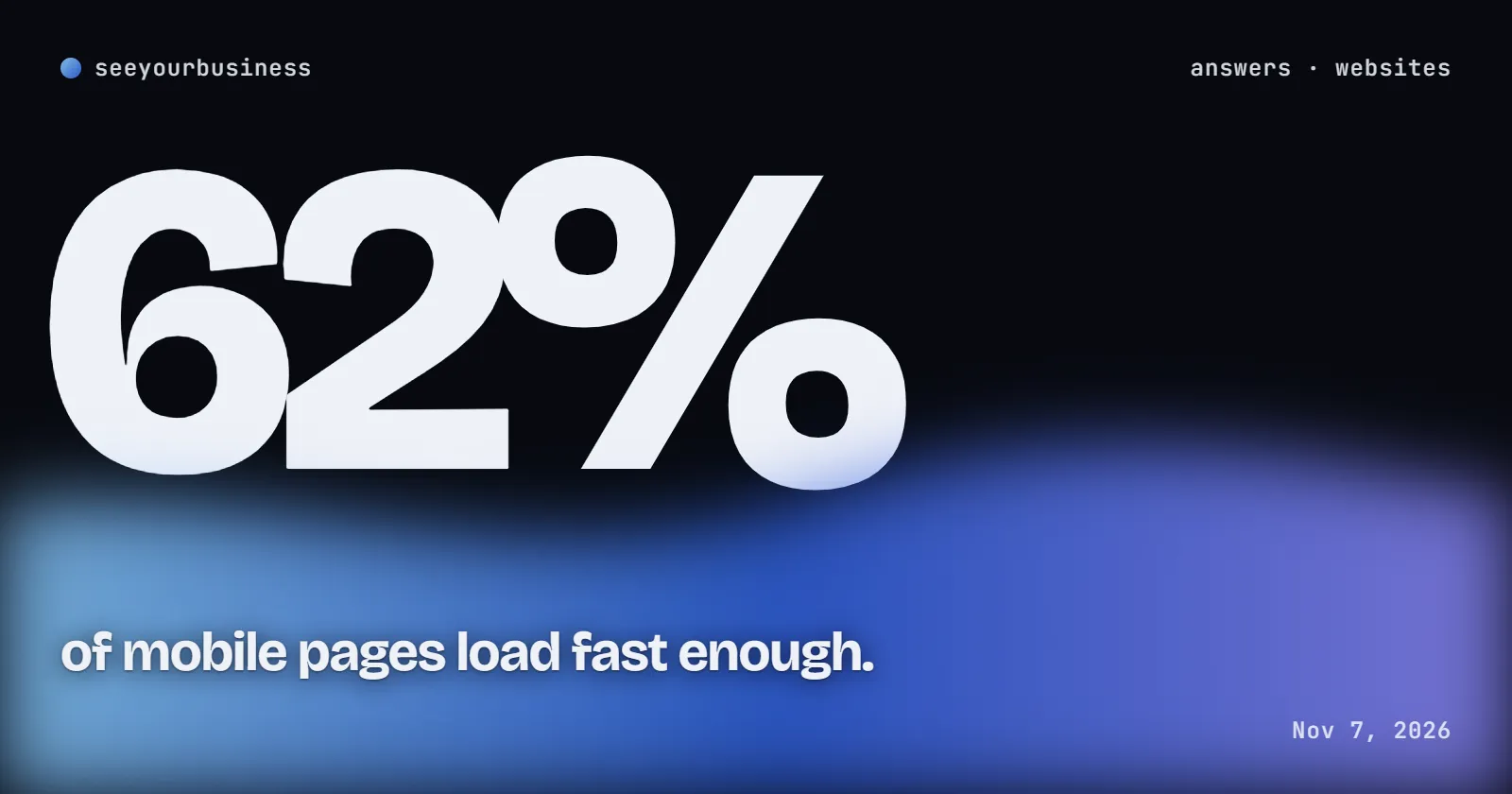
Many sites miss that mark on phones. The 2025 Web Almanac, a yearly study of how the web performs, found that 74% of desktop pages reach a good loading score but only 62% of mobile pages do. It also found that mobile pages have nearly double the rate of poor loading experiences. Put simply, the same website feels slower on the device your customers are most likely to use.
Think of a store with a door that sticks. Some people will push harder, but most will walk to the shop next door. A slow page works the same way, and the visitor never tells you they left.
The second cause is a first screen that does not answer the visitor. Nielsen Norman Group's advice is blunt: you have to communicate your value within 10 seconds to earn more of their time. For a local business, that means the screen visitors see before they scroll should say what you do, where you do it and how to reach you. A slogan does not do that job.
The plan: four fixes you can make this week
You can check most of this yourself, without paying anyone.
First, measure your speed on a phone. Open Google's PageSpeed Insights, paste in your homepage address and read the mobile result. web.dev lists PageSpeed Insights and the Core Web Vitals report in Search Console as the standard free tools for this. If the loading score is poor, the usual suspects are oversized photos, too many plug-ins and cheap hosting.
Second, rewrite the top of your homepage. In one or two plain sentences, say what you do, who you do it for and where. Then put one clear action next to it, such as "Call now" or "Get a quote." If a visitor has to scroll to find it, move it up.
Third, make the number a tap, not a task. On a phone, your number should be a tap-to-call link that sits in the header and stays visible as people scroll. Test it yourself: open your site on your own phone and try to call. If you hesitate, your customers will too.
Fourth, count the other doors. Check your contact form on a phone and see how many fields it asks for. Ask who receives the message and how fast they reply. A visitor who fills out a form at 7 p.m. and hears nothing until noon has often called someone else already.
If you would rather not rebuild it yourself, this is the work behind our marketing websites: pages that load fast, say the important thing first and make the next step obvious on a phone. The checks above are worth doing either way, because they tell you what is actually wrong before you spend money fixing it.
What this data does not tell you
None of these sources measures calls for businesses like yours. The Web Almanac describes how fast pages load across the web, and it does not say how many calls a faster page brings back. Nielsen Norman Group's study covers general browsing from 2010 data, not local service sites.
There are also causes that sit outside the website. If few people find your business in the first place, speed and wording will not help much, and your Google Business Profile or your reviews may be the real gap. If people do find you and still do not call, your prices, your hours or your reviews may be putting them off. We would check those too before blaming the design.
So treat the four fixes as a way to remove the most common obstacles, not a promise of a number. Our read is that a slow, vague page is the cheapest problem to fix and the first one to rule out.
What it looks like when it works
Go back to the plumber. The page appears quickly on a phone, the first screen says "Emergency plumbing in your town," and a tap-to-call button sits at the top. The customer with the wet floor taps once and calls, instead of scrolling for your number.
You will not see the visitors who used to leave. You will see calls coming in at the times when your phone used to stay quiet. If you want someone to build that page and connect the form to your calendar, that is what we do at See Your Business.
Sources
- How Long Do Users Stay on Web Pages?, Nielsen Norman Group, 2011-09-11
- Web Vitals, web.dev (Google), 2024-10-31
- Performance, HTTP Archive Web Almanac, 2026-05-05
- Americans' Use of Mobile Devices in 2026, Pew Research Center, 2026-10-19
Book a strategy call
Answer 3 quick questions so we come prepared. No essays.
You talk to the people who build it.
A 20-minute call. We look at your current site, tell you what we would change and what it should bring back.
Get the next post by email
One email per new post. No spam.